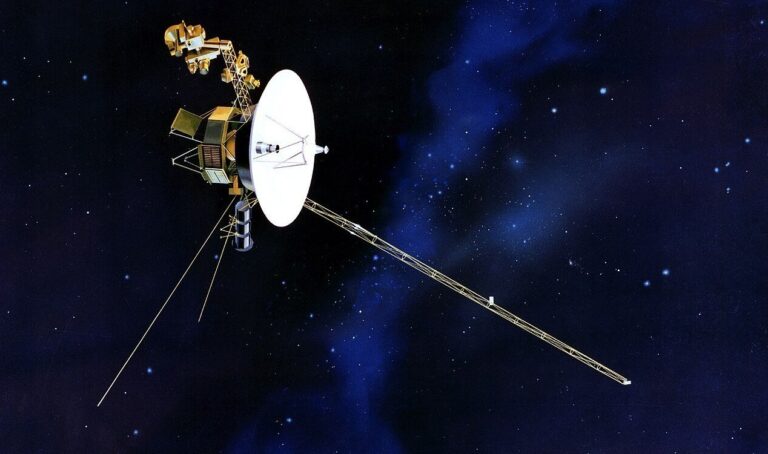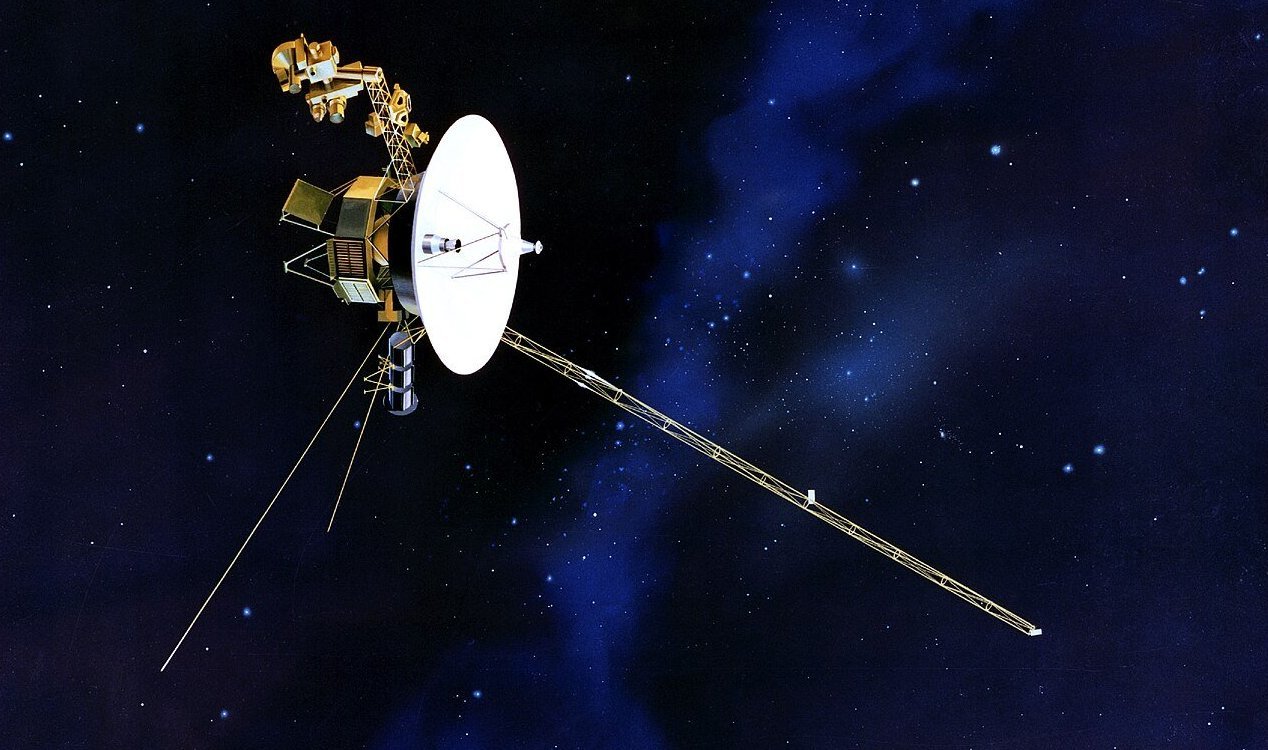
Nearly half a century after leaving Earth, NASA’s legendary Voyager 1 spacecraft is approaching a remarkable milestone: traveling far enough into space that a signal traveling at the speed of light would need an entire day to reach it.
That distance is approximately 25.9 billion kilometers, an almost unimaginable separation that makes Voyager 1 the first human-made object to reach this milestone.
Launched in 1977, Voyager 1 was originally designed to explore the outer planets of our Solar System. Along with its twin spacecraft, Voyager 2, it took advantage of a rare alignment of the giant planets that allowed NASA to study multiple worlds during a single mission. This unusual planetary arrangement occurs only once every 175 years.
What began as a mission to investigate distant planets eventually became something much greater. Both spacecraft continued traveling long after completing their original objectives, venturing beyond the boundary of the heliosphere and into interstellar space. Despite their extraordinary age and the immense distances involved, Voyager 1 and Voyager 2 have continued sending valuable scientific information back to Earth.
But Voyager 1’s journey is far from over. Scientists estimate that in approximately 40,000 years, the spacecraft will pass within about 1.7 light-years of a star known as AC +79 3888, which is currently located around 17.6 light-years from our Solar System.
After that encounter, the probe will continue drifting through the Milky Way, carrying with it the famous Golden Record containing sounds, images, and greetings from Earth.
One day, its instruments will finally stop transmitting, but the spacecraft itself will continue moving through space. Long after its mission ends, Voyager 1 may remain a silent reminder that humanity once reached beyond its own planetary neighborhood and sent a message toward the stars.
About The Author